Materials intelligence / Flexible photovoltaics

Value Beyond the Veil.

Engineering material interfaces and developing next-generation flexible photovoltaic technologies through computational science and artificial intelligence.

Explore our approach

01 / Our vision

Rethinking materials from the atomic scale.

We believe the next generation of materials and energy technologies begins with a deeper understanding of how materials interact.

At RCvelum, we bring together materials science, computational modeling, and artificial intelligence to bridge the gap between atomic-scale understanding and real-world material performance.

Our vision is to turn that understanding into technology: better-engineered material interfaces and durable, efficient, and flexible photovoltaics, including photovoltaic yarn.

02 / The scientific challenge

Performance begins at the interface.

Advanced materials rarely operate in isolation. Their performance depends not only on their individual properties but also on how they interact with surrounding materials.

In flexible photovoltaics, and especially in fiber-shaped devices that bend and twist in use, weak interfaces between functional layers can contribute to delamination, mechanical degradation, and reduced device lifetime.

Understanding and engineering these interfaces is central to our work.

InterfaceSeparation

Conceptual cross-section of three bonded material layers; the upper layer is fully attached along the interface.

FIG. 01 — Interface integrity (conceptual schematic).Delamination is the separation of bonded material layers. This schematic illustrates the concept; it is not a simulation or a prediction of failure.

03 / Our research approach

Connecting scales. Engineering interfaces.

We are building an AI-assisted, multiscale approach to materials engineering: computational models that connect atomic structure and interfacial interactions with the performance of real materials and devices.

By combining first-principles calculations, experimental characterization, and machine learning, we aim to guide interface engineering, identify more durable material combinations, and support the development of flexible photovoltaic systems.

FIG. 02 — Proposed multiscale research framework.
  1. Atomic Understanding

    Understanding atomic structures, chemical interactions, and material behavior through first-principles calculations.

  2. AI-Assisted Modeling

    Learning relationships between material structures, interactions, and properties through data-driven computational methods.

  3. Interface Engineering

    Investigating material compatibility, interfacial interactions, stability, and mechanical integrity.

  4. Device-Level Applications

    Translating materials intelligence into the design of flexible photovoltaic devices, including photovoltaic yarn.

04 / Research directions

Two research directions. One scientific foundation.

FIG. 03 — Atomic-scale structure at an interface (conceptual illustration).

AI-Driven Materials & Interface Engineering

Developing computational approaches to understand, predict, and optimize material interactions across multiple scales.

We apply them to interface engineering: choosing and refining material combinations so that functional layers bond well, remain stable, and withstand mechanical stress.
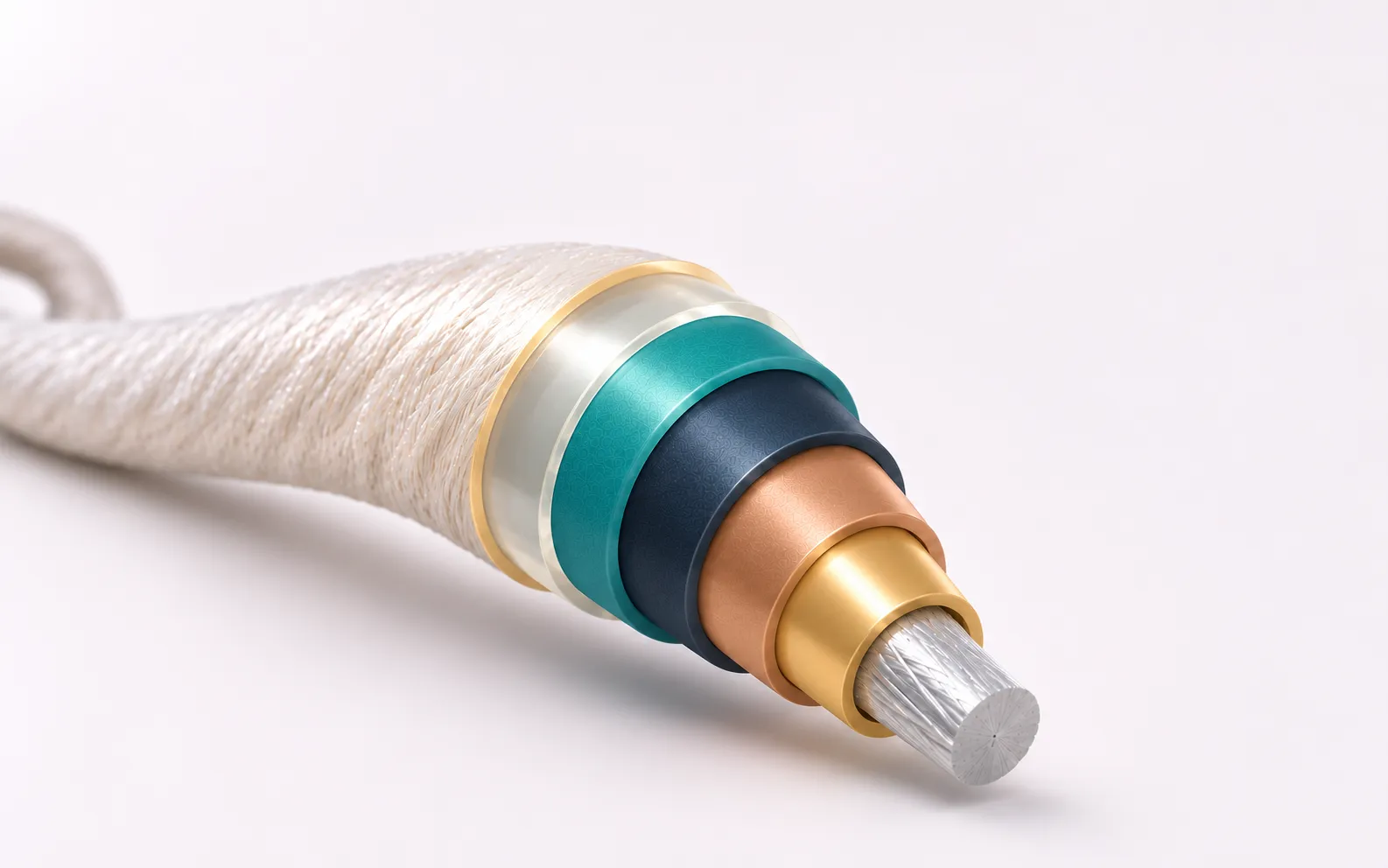

Cutaway rendering of a photovoltaic yarn concept: a fiber core surrounded by concentric functional layers, beneath a textile outer wrap.Exploded view of the same conceptual layer sequence as a flat stack: from top to bottom, barrier layer, electrode, electron transport layer, perovskite, hole transport layer, and substrate.
View
FIG. 04 — Photovoltaic yarn and its layer sequence (conceptual illustration).The same conceptual layers, matched by color: barrier, electrode, electron transport layer, perovskite, and hole transport layer, around a fiber core or on a flat substrate.

Next-Generation Flexible Photovoltaics

Exploring material systems and interface strategies for more stable, durable, and mechanically resilient flexible solar technologies.

A central focus is photovoltaic yarn: a layered solar architecture built around a flexible fiber core, with the aim of integrating power generation into textiles and other flexible structures.

05 / Research & development

Building the scientific foundation.

Our research brings together theoretical, computational, and experimental perspectives on materials engineering.

In practice, we focus on the interfaces between functional layers in flexible photovoltaic architectures, and on how those layers can be built up, bonded, and protected around a fiber to form photovoltaic yarn. The goal is to translate materials and interface knowledge into fabrication know-how and design choices for product-relevant systems.

Potential application areas include space, where low mass and flexibility matter; textiles, where power generation can be integrated into fabric; and defense, where lightweight, portable power is valuable.

  • R.01Materials & Interface ChemistryChemical interactions and material compatibility.
  • R.02First-Principles CalculationsAtomic-scale computational characterization.
  • R.03Machine Learning for MaterialsData-driven prediction of material properties.
  • R.04Multiscale ModelingConnecting atomic and macroscopic material behavior.
  • R.05Experimental CharacterizationConnecting computational insights with physical observations.
  • R.06Flexible & Fiber PhotovoltaicsInterface stability and mechanical integrity in flexible and yarn-based devices.

06 / The people behind RCvelum

Different disciplines. A shared vision.

RCvelum is an interdisciplinary team combining expertise in materials chemistry, computational science, experimental characterization, and artificial intelligence.

  • Portrait of Dr. Rıza Dervişoğlu

    Dr. Rıza Dervişoğlu

    Co-Founder · Materials Science & Chemistry

    Materials scientist and chemist with a PhD from the University of Cambridge. Expertise in solid-state chemistry, first-principles calculations, experimental spectroscopy, and atomic-scale characterization of functional materials, including halide perovskites.

    LinkedIn profile of Dr. Rıza Dervişoğlu
  • Portrait of Çağatay Akpınar

    Çağatay Akpınar

    Co-Founder · Computer Science & Artificial Intelligence

    Computer scientist specializing in artificial intelligence, machine learning, and data-driven modeling, with a focus on scalable computational tools for materials and interface engineering.

    LinkedIn profile of Çağatay Akpınar

07 / Collaboration

Turning science into technology, together.

We seek industrial, research, and funding partners who want to turn advances in materials and flexible photovoltaics into working technology.

How we can work together

  • Interface engineeringAnalyzing and improving the interfaces between functional layers for adhesion, stability, and mechanical integrity.
  • Photovoltaic yarn developmentDeveloping photovoltaic yarn and the processes to make it, together with partners.
  • Know-how transferSharing what we learn about how photovoltaic yarn can be made, from layer design to fabrication.
  • Strategic and funding partnershipsWorking with partners and funders who want to help take this technology from development toward production.